Spray Foam Removal & Correction
St. George Foam removes and corrects failed spray foam installs from other contractors - off-ratio chemistry, wrong product for the application, missing code-required coatings, and lingering odor complaints - and re-sprays it right.
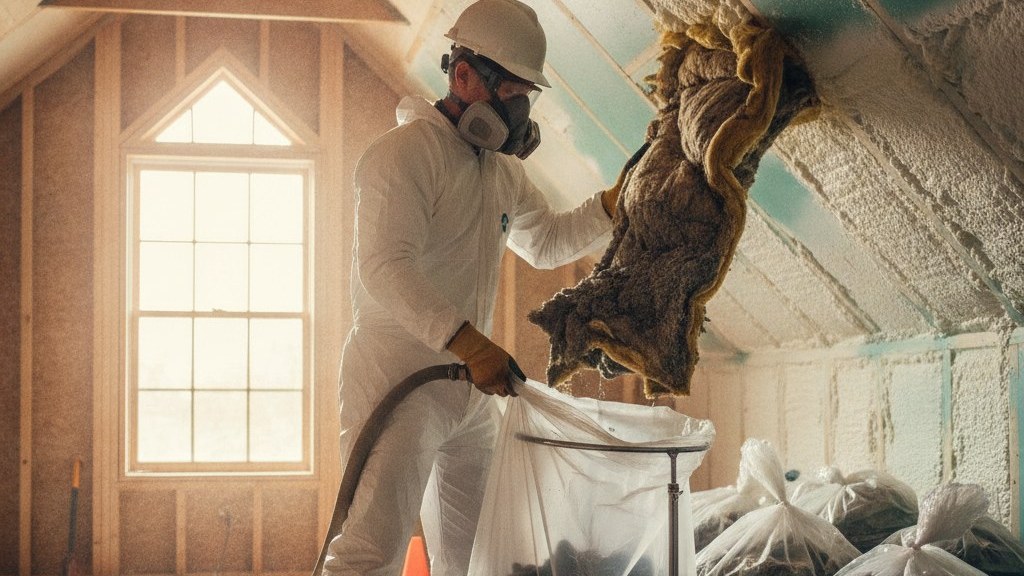
Spray foam is chemistry sprayed on-site by a technician, and when the process goes wrong, it goes wrong in specific, identifiable ways. The most common failure is off-ratio mixing: spray foam is a two-component system, an A-side and a B-side pumped through heated hoses at a precise ratio and temperature, and if that ratio drifts - from a miscalibrated rig, a bad hose heater, or an inexperienced technician not catching it mid-spray - the foam never cures properly. It stays tacky, spongy, or crumbly instead of setting into the rigid or semi-rigid structure it's supposed to have, and it often keeps off-gassing a chemical smell for weeks or months instead of clearing within a day or two like a correctly cured job.
The second common failure is the wrong product for the application - open-cell sprayed on an exposed roof deck where it should have been closed-cell, or foam sprayed directly over an active roof leak that trapped moisture against the decking instead of solving the problem. The third is a code miss: foam left exposed in living space without the required ignition-barrier coating over it, which shows up as a failed inspection, sometimes not caught until a home sale or a remodel opens the space back up.
We get called into these situations by homeowners who smell something wrong months after their spray foam install, by inspectors flagging a fail on a new-construction or remodel job, by home buyers whose pre-purchase inspection turned up bad foam in the attic or crawl space, and by general contractors who inherited a subcontractor's work mid-project and need it corrected before they can move forward. It's a distinct skill from a fresh install - diagnosing what actually went wrong, removing it without damaging the structure underneath, and re-spraying to a standard that will actually pass inspection and stop the complaint.
This isn't a side offering bolted onto our install business. We treat correction work as its own discipline, because the diagnostic step matters as much as the removal - spraying new foam over a problem that was never actually identified just buries the issue again.
Why homeowners choose it
- Accurate diagnosis of off-ratio, under-cured, or wrong-product foam before any removal begins
- Mechanical removal that protects roof decking, framing, and drywall underneath the failed foam
- Code-compliant re-install, including ignition-barrier coating where required
- Coordination with your local building inspector to close out a failed inspection
- Resolves ongoing chemical odor and off-gassing complaints tied to improperly cured foam
- Documentation of the correction for real estate transactions, appraisals, or disclosure needs
How to Tell Your Spray Foam Job Went Wrong
A properly cured spray foam job stops smelling within a day or two and sets into a firm, stable structure that stays bonded to whatever it was sprayed onto. When something's wrong, it usually shows up as one or more of a handful of recognizable signs, and homeowners are often relieved to learn there's a name for what they're dealing with rather than assuming it's just how spray foam always smells or feels.
- A tacky, soft, or spongy surface that never fully firms up, sometimes weeks after the install
- A persistent chemical odor that doesn't fade after the first few days
- Visible gaps, voids, or thin spots, especially at eaves, corners, and rim joists
- Foam pulling away or delaminating from the framing, decking, or metal panel it was sprayed on
- A crumbly, friable texture that flakes apart rather than holding its shape
- Missing ignition-barrier coating over foam that's exposed in living or storage space
What Removal & Correction Involves
We start with an on-site assessment - checking cure state, coverage, thickness, and whether the issue is isolated to one area or spread across the whole assembly. Off-ratio and failed foam gets mechanically removed by scraping and cutting rather than chemically dissolved, since that protects the roof decking, wall framing, or metal panel underneath from further damage. Removed material is hauled off, the substrate is inspected and cleaned, and we re-spray with the correct product, ratio, and thickness for the application - closed-cell where the original job wrongly used open-cell, proper ignition-barrier coating where it was missing the first time.
Working With Inspectors and Home Sales
When correction work is tied to a failed inspection, we coordinate directly with the inspector on what's needed to pass re-inspection and schedule the re-spray to line up with that timeline. For home sales, we can document the correction with photos and a written scope for the buyer, seller, or their agent, which is often exactly what's needed to move a stalled closing forward when bad foam turns up during a pre-purchase inspection.
Ideal for
- Homes with a failed inspection tied to spray foam insulation
- Homeowners still smelling a strong chemical odor weeks or months after a spray foam install
- Home buyers who found bad foam during a pre-purchase inspection
- General contractors who inherited a subcontractor's failed foam mid-project
- Commercial buildings with foam that's sagging, delaminating, or pulling away from the substrate
What affects the cost
Removal & Correction questions, answered
The clearest signs are a chemical smell that doesn't fade after a few days, foam that stays soft or tacky instead of firming up, visible gaps or voids, or a failed inspection. If any of that sounds familiar, an on-site assessment can tell you definitively rather than guessing.
A short-lived odor during the first day or two of a correctly cured job is normal and expected. A strong smell persisting for weeks or months usually points to off-ratio or under-cured foam, and we'd recommend having it assessed rather than assuming it will eventually clear on its own.
Yes - we regularly coordinate with buyers' inspectors, sellers' agents, and the original installing contractor's paperwork when a home sale is on hold over a bad spray foam finding.
Only the bad section, whenever that's technically possible - we assess coverage and cure state across the whole assembly first and remove only what's actually failed rather than defaulting to a full tear-out.
Removal & Correction done right, by a local Washington County crew
We're a full-service spray foam company — not a general insulation contractor that also offers spray foam as one option among many. Spray foam is the only material we install, but we don't limit the scope: residential and commercial, new construction, and correction of prior spray foam jobs other crews got wrong. Removal & Correction isn't a commodity, and the result depends entirely on how carefully it's scoped and installed for your specific building in a genuine hot-desert climate. We assess what your property actually needs, prep and air-seal properly, and install to your elevation-appropriate, IECC Zone 3B R-value target, so the work delivers the cooling-bill relief it's supposed to.
We serve St. George, Washington City, Hurricane, Santa Clara, Ivins, LaVerkin, and Toquerville. St. George's summers are the whole story here — dark roof decks push attic temperatures to 130-150°F+ from May through September, and that heat radiates straight down into living space and forces your AC to run nearly nonstop. We scope every job around that cooling load, not around a heating-season assumption borrowed from a colder climate. Every job starts with a free, no-pressure quote.
Just as important, we treat your home like the system it is. Insulation, air sealing, and ventilation all interact, and getting one right while ignoring the others leaves comfort and savings on the table. When we scope your removal & correction, we look at how it fits the whole picture — so the finished result performs the way it should, holds up through a genuine St. George summer, and actually lowers the AC bills you feel every month, whether you're served by Rocky Mountain Power (including its Wattsmart Homes program) or Dixie Power.
Free assessment
We evaluate your home and give you a clear, itemized quote.
Expert install
We prep, air seal, and install your removal & correction to spec — clean and on schedule.
Savings you can feel
A cooler home, lower AC bills, and honest advice about what your home needs.
Related services
Ready for a free removal & correction quote?
Tell us about your home and we'll put together a clear, no-pressure spray foam insulation quote — built for St. George's real summers.