Crawl Space Spray Foam Insulation
Closed-cell spray foam applied to crawl space perimeter walls and rim joists, sealing the vented crawl space out of the thermal envelope and cutting off one of the more overlooked energy-loss points in a Washington County home.
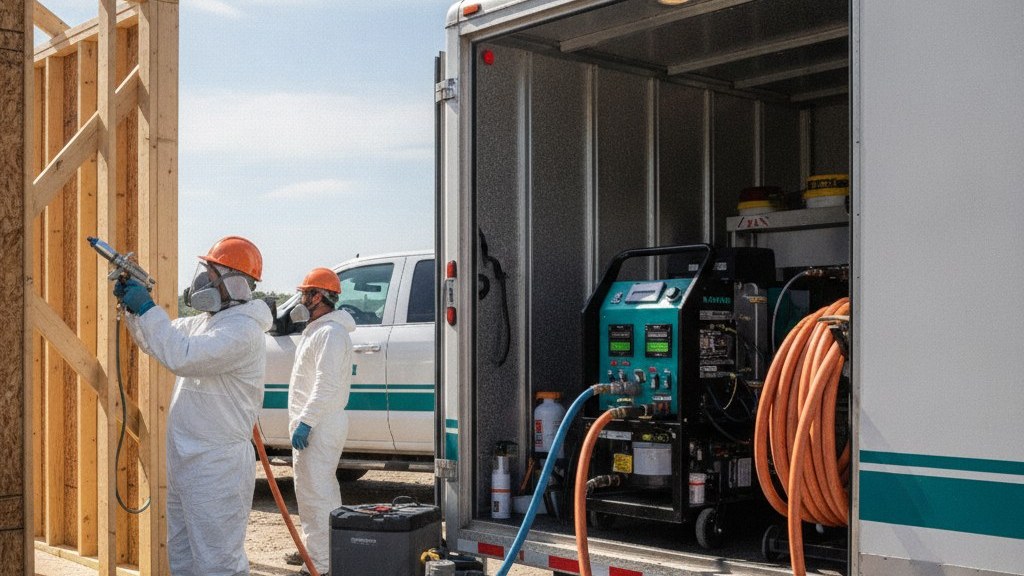
A lot of homes in Washington County still have vented, unconditioned crawl spaces built to an older standard - open foundation vents letting outside air, dust, and moisture move freely underneath the house. That worked fine as a construction method for decades, but it means the floor system above sits directly on top of whatever temperature and humidity happen to be under the house, and it means any ductwork running through the crawl space is losing conditioned air into unconditioned space with every cycle.
We seal that off by spraying closed-cell foam directly onto the crawl space perimeter foundation walls and rim joist band, effectively moving the crawl space envelope from the floor system down to the foundation wall itself. It's the same building-science logic as a roof-deck conversion, applied at the bottom of the house instead of the top: bring the space inside the thermal boundary instead of just insulating the floor above it.
Rim joists deserve their own mention because they're the single most commonly missed insulation gap in a typical Washington County home. It's the band of framing sitting directly on top of the foundation wall, running the full perimeter of the house, and in most standard construction it gets a thin strip of fiberglass at best - full of gaps at every joist bay. Sealing it with closed-cell foam closes one of the largest continuous air leaks in the entire building envelope.
Homes closer to the Virgin River bench around Hurricane and LaVerkin, and anywhere grade slopes toward the foundation after a monsoon downpour, see more crawl space moisture than homes further up the bench toward St. George proper. Closed-cell's resistance to bulk water makes it the right product for this application regardless of location, but it matters even more where seasonal moisture is a bigger factor.
Why homeowners choose it
- Removes the crawl space from the outside air stream, stopping conditioned-air loss through the floor system
- Seals rim joists, the most commonly under-insulated point in standard residential framing
- Resists ground and seasonal moisture far better than fiberglass batts hung between floor joists
- Improves floor comfort directly above the crawl space, especially in bathrooms and bedrooms over unconditioned areas
- Reduces energy loss from ductwork routed through the crawl space
- Cuts off dust, allergens, and outside air infiltration that vented crawl spaces pull into the house
Sealed vs. Vented Crawl Spaces
A vented crawl space lets outside air move freely underneath the house, following older building code that assumed venting prevented moisture problems. In practice, in a hot desert climate, venting just means the crawl space temperature tracks outside conditions almost exactly - hot in summer, and pulling humid monsoon-season air in during storm weeks. Sealing the perimeter with closed-cell foam and closing off the vents moves the space inside the building's thermal and moisture boundary instead.
Rim Joists: The Overlooked Leak Point
Standard construction typically insulates rim joists with a thin fiberglass strip cut to fit each joist bay, if it's insulated at all consistently. Every gap between those cut pieces is a direct air path from outside to the floor system above. We treat the rim joist band as its own dedicated pass on every crawl space job, spraying it continuously rather than leaving it as an afterthought around the perimeter sealing work.
What's Involved in a Crawl Space Job
We start by assessing crawl space height, access point, existing insulation condition, and any moisture or grading issues that should be addressed before spraying. Old, sagging, or contaminated batts get pulled out, foundation vents are typically sealed or mechanically closed, and closed-cell foam is sprayed across the perimeter wall and rim joist in a continuous pass sized to the target R-value for your specific crawl space depth.
Ideal for
- Homes with a vented, unconditioned crawl space and HVAC ductwork routed underneath
- Homes near the Virgin River bench around Hurricane and LaVerkin with more seasonal ground moisture
- Older homes with sagging, gapped, or missing fiberglass batts between floor joists
- Homeowners noticing cold or hot floors directly above the crawl space
- New construction crawl spaces being built sealed from the start rather than vented
What affects the cost
Crawl Space Spray Foam questions, answered
For sealed-crawl-space conversions we spray the perimeter foundation walls and rim joist band, not the ground itself, which is the current best-practice approach versus insulating between floor joists in a vented crawl space.
When it's done correctly - including a ground vapor barrier and proper foundation vent closure - a sealed crawl space typically runs drier than a vented one, since it's no longer pulling in outside humidity during the monsoon window. We assess ground moisture and grading as part of every quote.
We work around active ductwork carefully during spraying and can flag any obvious duct leaks or disconnections we notice while we're under the house, even though duct sealing itself isn't part of the insulation scope.
In most cases yes. Low-clearance crawl spaces take longer and get priced accordingly, but our crews regularly work in tight, low-height crawl spaces across older Washington County construction.
Crawl Space Spray Foam done right, by a local Washington County crew
We're a full-service spray foam company — not a general insulation contractor that also offers spray foam as one option among many. Spray foam is the only material we install, but we don't limit the scope: residential and commercial, new construction, and correction of prior spray foam jobs other crews got wrong. Crawl Space Spray Foam isn't a commodity, and the result depends entirely on how carefully it's scoped and installed for your specific building in a genuine hot-desert climate. We assess what your property actually needs, prep and air-seal properly, and install to your elevation-appropriate, IECC Zone 3B R-value target, so the work delivers the cooling-bill relief it's supposed to.
We serve St. George, Washington City, Hurricane, Santa Clara, Ivins, LaVerkin, and Toquerville. St. George's summers are the whole story here — dark roof decks push attic temperatures to 130-150°F+ from May through September, and that heat radiates straight down into living space and forces your AC to run nearly nonstop. We scope every job around that cooling load, not around a heating-season assumption borrowed from a colder climate. Every job starts with a free, no-pressure quote.
Just as important, we treat your home like the system it is. Insulation, air sealing, and ventilation all interact, and getting one right while ignoring the others leaves comfort and savings on the table. When we scope your crawl space spray foam, we look at how it fits the whole picture — so the finished result performs the way it should, holds up through a genuine St. George summer, and actually lowers the AC bills you feel every month, whether you're served by Rocky Mountain Power (including its Wattsmart Homes program) or Dixie Power.
Free assessment
We evaluate your home and give you a clear, itemized quote.
Expert install
We prep, air seal, and install your crawl space spray foam to spec — clean and on schedule.
Savings you can feel
A cooler home, lower AC bills, and honest advice about what your home needs.
Related services
Ready for a free crawl space spray foam quote?
Tell us about your home and we'll put together a clear, no-pressure spray foam insulation quote — built for St. George's real summers.