Commercial & Metal Building Spray Foam
Closed-cell spray foam engineered for metal buildings, warehouses, and commercial shops across Washington County - stopping panel condensation, cutting HVAC load in large-volume spaces, and dampening monsoon noise on metal roofs, work most residential-only crews in this market don't take on.
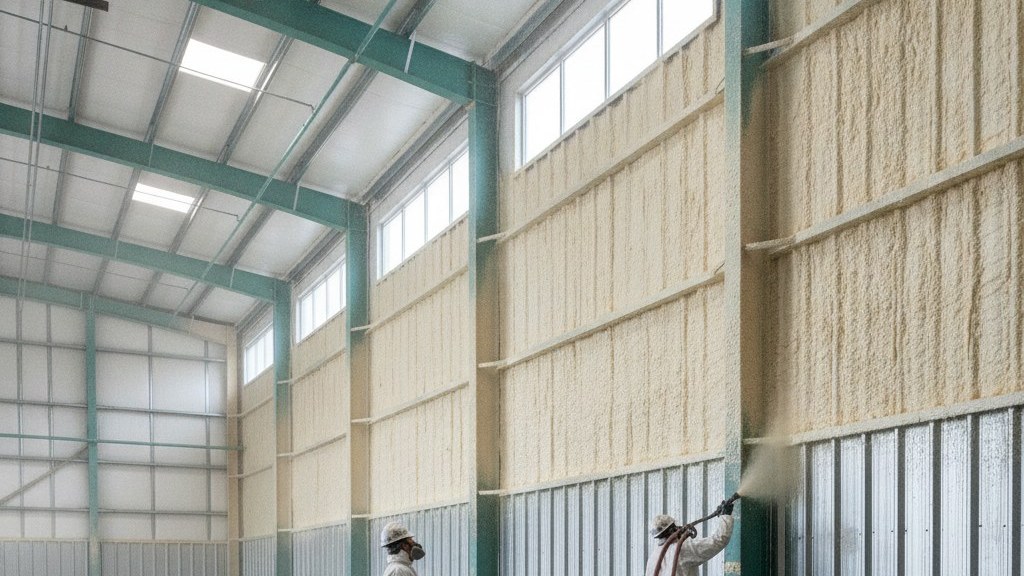
Metal buildings in St. George have a problem most owners don't fully understand until they see it firsthand: sweating steel. A metal roof or wall panel has almost no thermal mass, so it tracks outside air temperature almost instantly. On a clear desert night, even after a 105-degree day, radiant cooling can drop that panel's surface temperature below the interior dew point, and by early morning it's dripping condensation onto whatever's stored underneath - inventory, equipment, hay, vehicles, tools. This isn't a rare edge case here; it's a predictable, recurring problem tied directly to how the desert climate swings between day and night.
Spray foam solves it in a way fiberglass blanket-and-screw systems, still the default in a lot of pole barn and ag building construction, don't: closed-cell foam bonds directly to the metal panel, eliminating the air gap where condensation actually forms in the first place. There's no vapor barrier to fail, no blanket sagging away from the panel over time creating new gaps, and no seams for humid interior air to reach the cold steel surface behind the insulation.
This is a category of work most spray foam crews in this market don't take on at all - a lot of outfits here are built around residential attics and walls and simply don't run the crew size, lift equipment, or scheduling flexibility that commercial buildings need. We run it as a core part of the business, not a side job, which means we can quote and staff a 20,000 square foot warehouse the same week we're doing a two-car garage.
The building types we work most often are self-storage facilities, RV and boat storage buildings, agricultural and ranch buildings, steel-frame shops, and pole barns across Washington County - anywhere metal panel construction meets a desert climate that swings 30 to 40 degrees between afternoon peak and pre-dawn low, even in the middle of summer.
Why homeowners choose it
- Stops condensation dripping onto stored inventory, equipment, or vehicles inside metal buildings
- Bonds directly to steel panels and purlins with no separate vapor barrier layer required
- Noticeably dampens rain and hail noise on metal roofing during monsoon storms
- Reduces HVAC load in large-volume commercial and agricultural buildings
- Adds a thermal break at purlins and girts that bare metal framing doesn't provide
- Faster single-pass install than removing and replacing a failed blanket-and-vapor-barrier system
Why Metal Buildings Sweat in the Desert
It seems counterintuitive that a building in one of the hottest parts of Utah has a condensation problem, but it's precisely the desert's dry-air, high-diurnal-swing climate that causes it. Low humidity means clear skies most nights, and clear skies mean strong radiant cooling of exposed metal surfaces - a roof panel can radiate heat to the night sky fast enough to drop well below the ambient air temperature, and well below the interior dew point of a building holding any moisture at all from equipment, vehicles, livestock, or simple occupancy.
Once that panel surface drops below dew point, moisture condenses directly on the steel, and without a thermal break or vapor-sealed insulation layer between the panel and the interior, that water finds its way onto whatever's stored below - and over years, onto the steel framing itself, where it becomes a corrosion problem rather than just a nuisance.
Direct-to-Metal Application
We spray closed-cell foam directly onto roof panels, wall panels, and purlins from the interior, building up to the target thickness for the building's use case - a climate-controlled shop calls for more R-value than an ag building that just needs condensation stopped. The direct adhesion means there's no gap for interior humidity to reach the cold steel behind the insulation, which is the actual mechanism that ends the sweating problem, not just insulating value on a spec sheet.
Commercial Timelines and Crew Scheduling
We staff commercial jobs with lift equipment and crew sizes to match the building rather than sending a residential-sized crew to a warehouse. For occupied buildings, we can schedule around business hours, work in sections to keep part of the facility operational, or run overnight and weekend passes when that fits the owner's operation better. Reach us at 844-967-5247 to talk through scheduling for your specific building and use case.
Ideal for
- Metal warehouses, shops, and light-industrial buildings
- Self-storage facilities and RV or boat storage buildings
- Agricultural buildings, barns, and ranch structures
- Pole barns and steel-frame outbuildings without an existing insulation package
- Church buildings, event halls, and other metal-frame commercial structures
What affects the cost
Commercial & Metal Building questions, answered
It depends on the extent and type of surface condition - light surface rust is usually fine after prep, but heavier corrosion may need treatment or panel repair first. We inspect the substrate as part of every commercial estimate before quoting.
By bonding directly to the metal panel, closed-cell foam eliminates the air gap and vapor pathway that lets interior humidity reach the cold steel surface where condensation actually forms. It's a mechanical fix, not just added R-value.
Yes - we regularly schedule commercial jobs in sections, overnight, or on weekends to keep occupied buildings operational during the install. Tell us your constraints when you call and we'll build the schedule around them.
Both, depending on the building's condensation and thermal goals. Roof-only passes are common for basic condensation control on ag and storage buildings; occupied shops and offices usually get walls included for comfort as well.
Commercial & Metal Building done right, by a local Washington County crew
We're a full-service spray foam company — not a general insulation contractor that also offers spray foam as one option among many. Spray foam is the only material we install, but we don't limit the scope: residential and commercial, new construction, and correction of prior spray foam jobs other crews got wrong. Commercial & Metal Building isn't a commodity, and the result depends entirely on how carefully it's scoped and installed for your specific building in a genuine hot-desert climate. We assess what your property actually needs, prep and air-seal properly, and install to your elevation-appropriate, IECC Zone 3B R-value target, so the work delivers the cooling-bill relief it's supposed to.
We serve St. George, Washington City, Hurricane, Santa Clara, Ivins, LaVerkin, and Toquerville. St. George's summers are the whole story here — dark roof decks push attic temperatures to 130-150°F+ from May through September, and that heat radiates straight down into living space and forces your AC to run nearly nonstop. We scope every job around that cooling load, not around a heating-season assumption borrowed from a colder climate. Every job starts with a free, no-pressure quote.
Just as important, we treat your home like the system it is. Insulation, air sealing, and ventilation all interact, and getting one right while ignoring the others leaves comfort and savings on the table. When we scope your commercial & metal building, we look at how it fits the whole picture — so the finished result performs the way it should, holds up through a genuine St. George summer, and actually lowers the AC bills you feel every month, whether you're served by Rocky Mountain Power (including its Wattsmart Homes program) or Dixie Power.
Free assessment
We evaluate your home and give you a clear, itemized quote.
Expert install
We prep, air seal, and install your commercial & metal building to spec — clean and on schedule.
Savings you can feel
A cooler home, lower AC bills, and honest advice about what your home needs.
Related services
Ready for a free commercial & metal building quote?
Tell us about your home and we'll put together a clear, no-pressure spray foam insulation quote — built for St. George's real summers.