Open-Cell Spray Foam Insulation
Lighter, more affordable spray foam built for interior wall cavities and attic floors, where air-sealing and sound control matter more than raw density - and where St. George Foam specs it deliberately, not as a discount substitute for closed-cell.
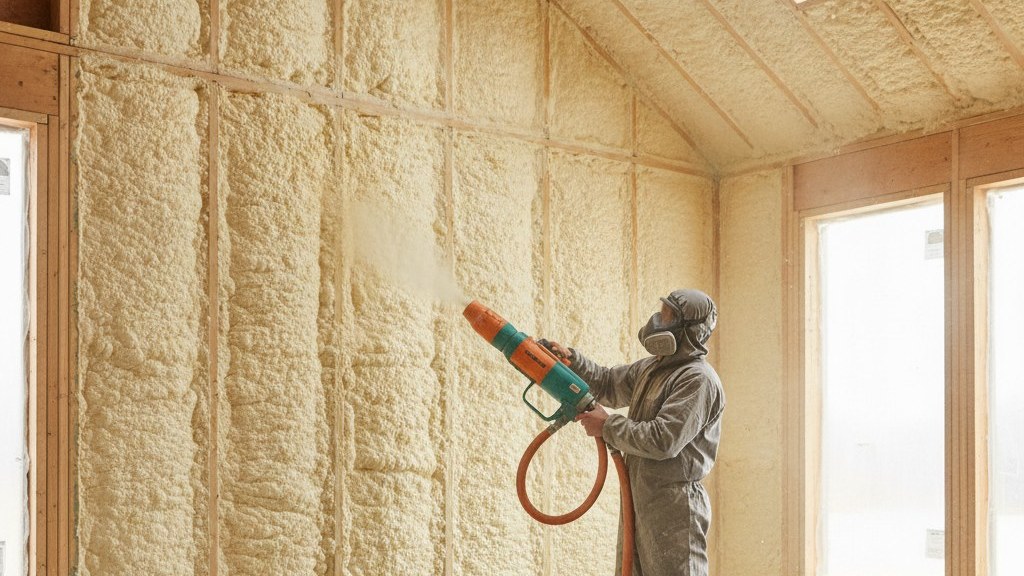
Open-cell spray foam cures to roughly R-3.5 to R-3.7 per inch, expanding aggressively into a soft, spongy structure that fills a stud bay or attic floor joist cavity completely, wrapping around wiring, plumbing, and blocking without the pressure buildup that can bow thin drywall or sheathing. It costs less per square foot than closed-cell, and for interior applications that don't need moisture resistance or added rigidity, that lower price isn't a compromise - it's the right tool for the job.
The real value of open-cell isn't the R-value on the spec sheet, it's air sealing. Fiberglass batts slow heat transfer but never stop air movement; a house full of batts still leaks conditioned air around every outlet box, top plate, and duct penetration. Open-cell foam closes those gaps directly, which is what actually keeps a St. George house from feeling like it's fighting a losing battle against 105-degree air infiltration all summer.
As a full-service shop we spec open-cell specifically where it earns its place: interior partition walls, attic floors in homes keeping a traditional vented attic, additions with open framing, and as one half of a hybrid system where closed-cell handles the roof deck or exterior envelope and open-cell fills interior cavities for cost efficiency and sound control. We're not trying to upsell every job to closed-cell, and we're not defaulting to open-cell everywhere to save on material either - the application dictates the product.
Open-cell also does something batts can't touch: it cuts sound transfer between rooms noticeably. In the open, great-room-style floor plans common in newer St. George and Washington City construction, that shows up as a real, felt difference between a primary suite and an adjacent laundry room, or around a home office and the rest of the house.
Why homeowners choose it
- Lower material and installed cost than closed-cell, useful on larger cavity or whole-attic projects
- Expands fully into irregular stud bays, around wiring, plumbing, and blocking
- Strong air-sealing performance against hot, dry outdoor air infiltration
- Noticeably reduces sound transfer between interior rooms compared to batt insulation
- Lightweight, non-load-bearing formulation that won't stress ceiling or wall framing
- Works cleanly alongside closed-cell in a hybrid system on the same job
What Open-Cell Is Good At (and Where It Isn't)
Open-cell is not a moisture barrier and it's not the product for a roof deck, an exterior-adjacent wall assembly, or a crawl space perimeter - those applications belong to closed-cell, and we'll say so plainly during the estimate rather than defaulting to whichever product is on the truck. Where open-cell earns its spot is interior, conditioned-space work where air-sealing and cost efficiency are the priority and there's minimal moisture exposure.
Its soft, flexible cell structure is also a real installation advantage in retrofit walls packed with old wiring and fixtures - it conforms around obstructions without the expansion pressure that dense closed-cell can put on thin materials, which usually means a cleaner, faster job in a remodel wall cavity.
Air Sealing and the St. George Cooling Load
Washington County's cooling season runs from roughly May through September, with July highs regularly hitting 104-106 degrees. Every unsealed gap in an interior wall or attic floor is a pathway for that heat to work its way toward conditioned space, and it doesn't matter how thick the batt insulation is if the air is moving around it rather than through it. Open-cell foam closes that pathway directly at the top plates, can-light housings, duct boots, and plumbing penetrations that fiberglass simply can't seal.
Hybrid Systems We Build
A lot of the homes we work on end up with both products on the same job: closed-cell at the roof deck or crawl space perimeter where moisture resistance and rigidity matter, open-cell filling interior partition walls and attic floor cavities where air-sealing and cost efficiency are the priority. We run both materials on the same crew day, so hybrid jobs don't mean scheduling two separate visits or two separate estimates.
Ideal for
- Interior partition walls between bedrooms, bathrooms, offices, and living spaces
- Attic floors in homes keeping a traditional vented attic rather than converting to roof-deck
- New-construction interior framing before drywall goes up
- Additions and remodels with open wall cavities
- Homes pairing open-cell interior walls with closed-cell at the roof deck or exterior envelope
What affects the cost
Open-Cell Spray Foam questions, answered
It's different, not worse. Open-cell trades density and moisture resistance for a lower cost and excellent air-sealing performance, which is exactly what interior walls and vented attic floors need. Closed-cell is the right call where moisture resistance or rigidity matters - open-cell is the right call where it doesn't.
Yes - St. George's monsoon window from mid-July into September is short, and outside of it ambient humidity stays low. For interior wall and attic-floor applications, open-cell's moisture permeability isn't a functional issue in this climate the way it can be in genuinely humid regions.
Regularly. It's one of the most common configurations we install - closed-cell at the roof deck or crawl space, open-cell in interior partition walls and attic floor area, sprayed by the same crew in one visit.
It's a noticeable, felt difference rather than a lab number most homeowners care about - open-cell in an interior partition wall meaningfully quiets voices, plumbing noise, and footfall transfer compared to a standard fiberglass batt wall.
Open-Cell Spray Foam done right, by a local Washington County crew
We're a full-service spray foam company — not a general insulation contractor that also offers spray foam as one option among many. Spray foam is the only material we install, but we don't limit the scope: residential and commercial, new construction, and correction of prior spray foam jobs other crews got wrong. Open-Cell Spray Foam isn't a commodity, and the result depends entirely on how carefully it's scoped and installed for your specific building in a genuine hot-desert climate. We assess what your property actually needs, prep and air-seal properly, and install to your elevation-appropriate, IECC Zone 3B R-value target, so the work delivers the cooling-bill relief it's supposed to.
We serve St. George, Washington City, Hurricane, Santa Clara, Ivins, LaVerkin, and Toquerville. St. George's summers are the whole story here — dark roof decks push attic temperatures to 130-150°F+ from May through September, and that heat radiates straight down into living space and forces your AC to run nearly nonstop. We scope every job around that cooling load, not around a heating-season assumption borrowed from a colder climate. Every job starts with a free, no-pressure quote.
Just as important, we treat your home like the system it is. Insulation, air sealing, and ventilation all interact, and getting one right while ignoring the others leaves comfort and savings on the table. When we scope your open-cell spray foam, we look at how it fits the whole picture — so the finished result performs the way it should, holds up through a genuine St. George summer, and actually lowers the AC bills you feel every month, whether you're served by Rocky Mountain Power (including its Wattsmart Homes program) or Dixie Power.
Free assessment
We evaluate your home and give you a clear, itemized quote.
Expert install
We prep, air seal, and install your open-cell spray foam to spec — clean and on schedule.
Savings you can feel
A cooler home, lower AC bills, and honest advice about what your home needs.
Related services
Ready for a free open-cell spray foam quote?
Tell us about your home and we'll put together a clear, no-pressure spray foam insulation quote — built for St. George's real summers.