Closed-Cell Spray Foam Insulation
Dense, rigid, R-6 to R-7 per inch spray foam that St. George Foam runs across the toughest applications on our schedule - roof decks, exterior walls, crawl space perimeters, rim joists, and metal building interiors - anywhere moisture resistance and structural add-on matter as much as R-value.
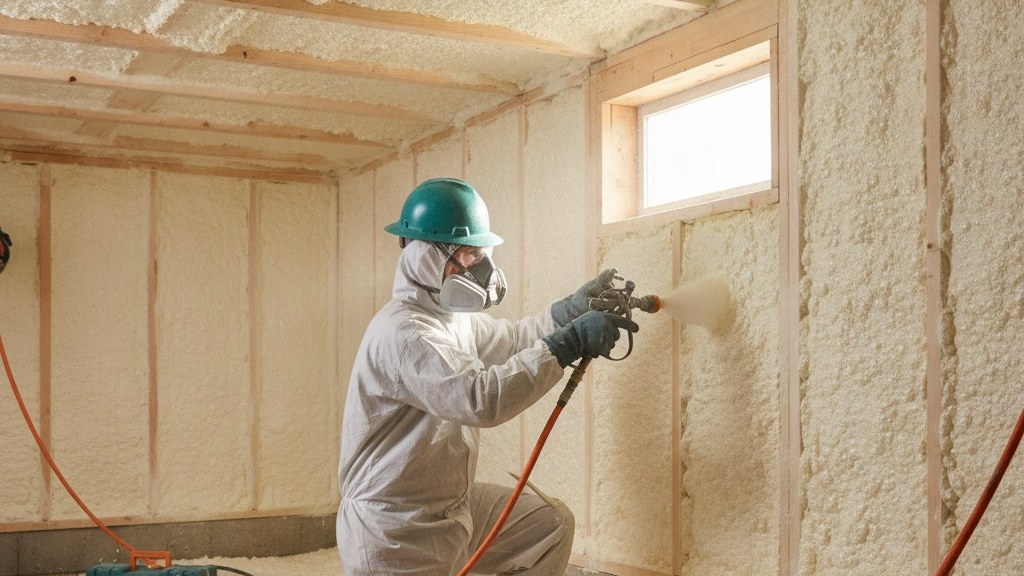
Closed-cell spray foam is the dense, rigid product in our lineup, curing at roughly R-6 to R-7 per inch - close to double the insulating value of open-cell foam for the same cavity depth. That density comes from a tighter cell structure packed with an insulating gas rather than open air pockets, which is also what makes closed-cell resistant to bulk moisture and largely impermeable to water vapor. It's the product we reach for on the jobs where thin-cavity performance, moisture control, or added rigidity actually matter, not just wherever the highest R-value sounds good on paper.
That rigidity is a real, practical benefit on top of the insulation value. A wall or roof deck sprayed with two to three inches of closed-cell foam gains meaningful stiffness beyond what the framing alone provides, which is part of why it's the standard product for pole barns, steel-frame shops, and metal buildings - it adds structural contribution at the same time it's controlling temperature and condensation on the panel. We spec closed-cell across residential and commercial work interchangeably; the chemistry doesn't care whether it's going on 2x6 wood studs in a Santa Clara home or steel purlins in a Hurricane warehouse.
On roof decks, closed-cell is usually the right call over open-cell because it's spraying directly against a surface that sees real temperature swings and, occasionally, minor roof leaks before anyone notices them - closed-cell's vapor resistance means it won't wick and hold that moisture against the sheathing the way an open-cell application can. The same logic applies below grade at crawl space perimeter walls and at rim joists, where the foam sits close to soil moisture, seasonal grade water, and outside air infiltration all at once.
We keep closed-cell in stock and running on crews every week rather than special-ordering it for the occasional job, which is part of why we can move fast on tight-turnaround commercial work and same-week residential projects without the material lead time other shops run into.
Why homeowners choose it
- Roughly double the R-value per inch of open-cell foam, useful where cavity depth is limited
- Adds meaningful structural rigidity to stud walls, roof decks, and metal building framing
- Highly resistant to bulk water and largely impermeable to water vapor
- Reduces condensation risk on cold surfaces like metal roof panels and rim joists
- Bonds directly to wood, concrete, and steel without a separate vapor barrier layer
- Holds up well in exposed applications - crawl space walls, rim joists, roof decks - where open-cell isn't recommended
Why Density Matters More Than R-Value Alone
It's tempting to shop spray foam purely on R-value per inch, but density is really what you're paying for with closed-cell - the R-value is a side effect of a cell structure built to resist water, add stiffness, and hold up in exposed, unconditioned, or high-swing-temperature applications. A rim joist or crawl space wall doesn't need R-20; it needs a material that won't degrade sitting a few inches off graded soil through a monsoon season.
That's the calculation we walk customers through when they ask why one part of the house gets closed-cell and another gets open-cell on the same job. It's rarely just a budget decision - it's matching the product to what that specific assembly is exposed to.
Where We Run Closed-Cell Across Residential & Commercial Jobs
On the residential side, closed-cell shows up most on roof decks, crawl space perimeters, rim joists, and garage ceilings under living space above. On the commercial side, it's close to the default product for metal building interiors, where its direct-to-steel adhesion and vapor resistance solve the condensation problem that plagues uninsulated or fiberglass-blanketed pole barns and warehouses.
- Roof decks and cathedral ceilings
- Crawl space perimeter walls and rim joists
- Metal building walls, roofs, and purlins
- Garage ceilings below finished living space
- Exterior walls in tight 2x4 framing where every R-point per inch counts
Installation & Cure
Closed-cell is sprayed in lifts, typically an inch to an inch and a half at a pass, to control the exothermic reaction and keep the foam curing evenly rather than overheating in one thick application. A finished thickness of two to three inches is common on roof decks and walls; crawl space and rim joist work is usually sized to the specific R-target rather than a flat number. Full cure is fast - the assembly is typically ready to close in or drywall within 24 hours.
Ideal for
- Roof decks under tile, metal, or asphalt shingle roofing
- Exterior walls where cavity depth is limited and maximum R-value per inch matters
- Crawl space perimeter walls and rim joists exposed to ground moisture
- Metal building and pole barn interiors needing condensation control
- Any application where added structural rigidity is a bonus, not just insulation
What affects the cost
Closed-Cell Spray Foam questions, answered
Closed-cell is denser, roughly double the R-value per inch, resists water, and adds real stiffness to the assembly it's sprayed into. Open-cell is lighter, cheaper per square foot, and better suited to interior cavities where air-sealing and cost matter more than moisture resistance or rigidity.
Yes - it's the primary product we use on metal building interiors because it bonds directly to steel panels and purlins and controls the condensation ('sweating') that's common on uninsulated or poorly insulated metal roofs in this climate.
It depends on the application and target R-value - roof decks commonly run 2 to 3 inches, rim joists and crawl space walls are often sized closer to 1.5 to 2 inches. We size it during the on-site walkthrough rather than quoting a flat thickness for every job.
At around 2 inches or more it functions as a Class II vapor retarder in most residential applications, which is generally sufficient for our climate zone without needing a separate poly sheet behind it. We'll flag it specifically if your assembly needs anything additional.
Closed-Cell Spray Foam done right, by a local Washington County crew
We're a full-service spray foam company — not a general insulation contractor that also offers spray foam as one option among many. Spray foam is the only material we install, but we don't limit the scope: residential and commercial, new construction, and correction of prior spray foam jobs other crews got wrong. Closed-Cell Spray Foam isn't a commodity, and the result depends entirely on how carefully it's scoped and installed for your specific building in a genuine hot-desert climate. We assess what your property actually needs, prep and air-seal properly, and install to your elevation-appropriate, IECC Zone 3B R-value target, so the work delivers the cooling-bill relief it's supposed to.
We serve St. George, Washington City, Hurricane, Santa Clara, Ivins, LaVerkin, and Toquerville. St. George's summers are the whole story here — dark roof decks push attic temperatures to 130-150°F+ from May through September, and that heat radiates straight down into living space and forces your AC to run nearly nonstop. We scope every job around that cooling load, not around a heating-season assumption borrowed from a colder climate. Every job starts with a free, no-pressure quote.
Just as important, we treat your home like the system it is. Insulation, air sealing, and ventilation all interact, and getting one right while ignoring the others leaves comfort and savings on the table. When we scope your closed-cell spray foam, we look at how it fits the whole picture — so the finished result performs the way it should, holds up through a genuine St. George summer, and actually lowers the AC bills you feel every month, whether you're served by Rocky Mountain Power (including its Wattsmart Homes program) or Dixie Power.
Free assessment
We evaluate your home and give you a clear, itemized quote.
Expert install
We prep, air seal, and install your closed-cell spray foam to spec — clean and on schedule.
Savings you can feel
A cooler home, lower AC bills, and honest advice about what your home needs.
Related services
Ready for a free closed-cell spray foam quote?
Tell us about your home and we'll put together a clear, no-pressure spray foam insulation quote — built for St. George's real summers.