Exterior Wall Spray Foam Insulation
Open-cell or closed-cell foam sprayed into exterior wall cavities on new-construction framing and open-wall remodels, sized to hit IECC Climate Zone 3B performance targets without over-building the assembly.
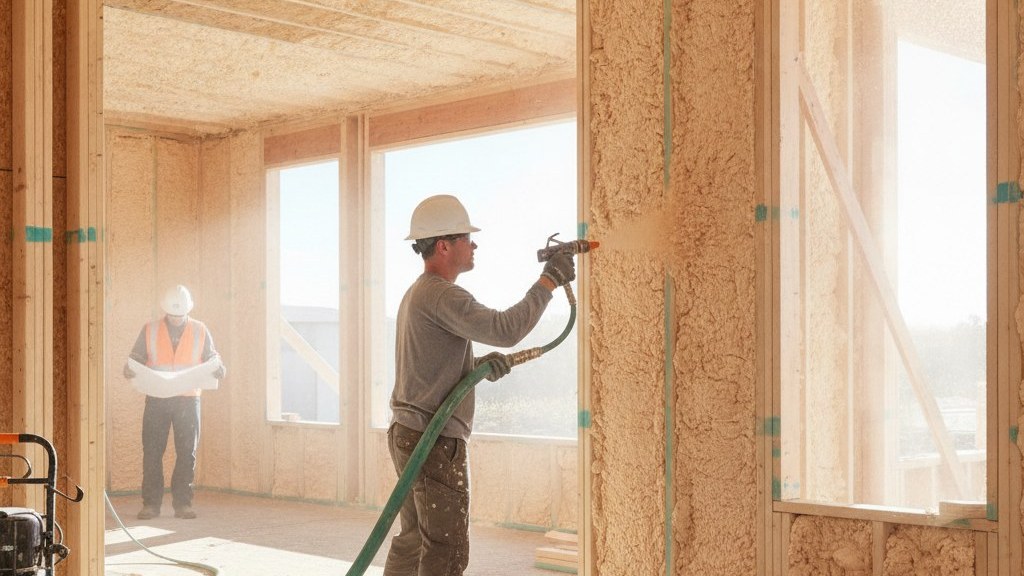
Exterior wall performance is where a lot of a home's cooling load gets decided, and it's also where the choice between open-cell and closed-cell matters most, because the wrong call in a 2x4 or 2x6 cavity either underperforms or wastes money. We spray exterior walls on new-construction framing before drywall goes up, and on remodels and additions where walls are opened for other work, sizing the product and thickness to actually hit Climate Zone 3B targets rather than defaulting to whatever's cheapest or whatever's on the truck that day.
Open framing is the reality of this work - spray foam is installed into open stud bays, not blown or injected behind finished drywall. That means the strongest fit is new construction, where we're on-site between the framer and the drywaller, and remodels or additions where walls are already opened up for electrical, plumbing, or window work. If your walls are closed and finished, exterior wall spray foam generally isn't the retrofit path; we'll say so directly rather than quoting a job that doesn't make sense for your house.
Washington County sits in IECC Climate Zone 3B, and production and custom builders across St. George, Santa Clara, and Ivins are increasingly speccing spray foam into exterior walls specifically to hit code more comfortably and future-proof against tightening energy requirements. We work directly with builders and GCs on this, scheduling around framing and rough-in inspections rather than treating spray foam as an afterthought bolted onto the tail end of a build.
On remodels, exterior wall foam shows up most often on garage-to-living-space conversions, room additions, and whole-house re-insulation projects where a homeowner is already gutting walls for other reasons and it makes sense to upgrade the envelope while everything is exposed.
Why homeowners choose it
- Sized to Climate Zone 3B performance targets rather than a one-size-fits-all thickness
- Air-seals the wall cavity in a way batt insulation behind a house wrap cannot match
- Open-cell or closed-cell selected based on cavity depth, budget, and exposure
- Scheduled directly with framers and GCs to fit standard rough-in inspection timelines
- Reduces the outdoor-to-indoor heat transfer that drives peak-summer AC runtime
- Improves interior sound isolation from street noise on exterior-facing walls
New Construction vs. Remodel Wall Cavities
New construction is the cleanest application: framing is complete, electrical and plumbing rough-in is done, and the crew has full, unobstructed access to every stud bay before insulation inspection. We coordinate directly with the builder's schedule so the spray happens in the same window a batt subcontractor would normally be on-site.
Remodel work is more variable - it depends entirely on how much of the wall is actually open. A gutted addition wall behaves like new construction; a wall opened only around a single window replacement doesn't have enough exposed cavity to make spray foam practical, and we'll tell a homeowner that upfront instead of quoting a job that doesn't fit the scope of what's actually accessible.
Meeting Climate Zone 3B Code
St. George falls under IECC Climate Zone 3B, which sets minimum insulation and air-sealing performance for new construction and major renovations. Spray foam's air-sealing properties help exterior wall assemblies meet code with less reliance on separate house-wrap taping and caulking details, and closed-cell in particular can help thinner wall assemblies hit target R-values without adding framing depth.
Working With Your Builder or GC
We work as a direct sub to builders and general contractors across Washington County, scheduling around framing completion and coordinating with the rough-in inspection so insulation goes in at the right point in the build sequence. If you're a GC managing multiple lots or phases, we can talk through a standing schedule rather than quoting each house one at a time - reach us at 844-967-5247 or josh@contractorschoiceagency.com.
Ideal for
- Custom and production home builders framing new construction in St. George, Santa Clara, and Ivins
- Additions with new exterior wall framing that need to match or exceed the existing envelope
- Garage-to-living-space conversions where exterior walls are being reframed or exposed
- Whole-house remodels where exterior walls are opened for other renovation work
- Homeowners targeting stricter energy performance than standard batt-and-house-wrap construction
What affects the cost
Exterior Wall Spray Foam questions, answered
Generally no - exterior wall spray foam is installed into open stud bays, not injected behind finished drywall. If your walls are closed, we'll talk through whether a different service, like attic or crawl space work, gets you more comfort improvement for the dollar.
Yes, when it's sized correctly for the wall assembly. We coordinate directly with builders around rough-in and insulation inspections so the install lines up with what the inspector is checking for.
It depends on cavity depth, budget, and whether the wall is exposed to more moisture than a typical interior condition. We'll walk the framing with you and make a specific recommendation rather than a blanket answer.
We schedule directly with the builder or GC's timeline, typically after framing and rough-in inspection are complete and before drywall starts. We work with several builders across St. George, Santa Clara, and Ivins on a recurring basis.
Exterior Wall Spray Foam done right, by a local Washington County crew
We're a full-service spray foam company — not a general insulation contractor that also offers spray foam as one option among many. Spray foam is the only material we install, but we don't limit the scope: residential and commercial, new construction, and correction of prior spray foam jobs other crews got wrong. Exterior Wall Spray Foam isn't a commodity, and the result depends entirely on how carefully it's scoped and installed for your specific building in a genuine hot-desert climate. We assess what your property actually needs, prep and air-seal properly, and install to your elevation-appropriate, IECC Zone 3B R-value target, so the work delivers the cooling-bill relief it's supposed to.
We serve St. George, Washington City, Hurricane, Santa Clara, Ivins, LaVerkin, and Toquerville. St. George's summers are the whole story here — dark roof decks push attic temperatures to 130-150°F+ from May through September, and that heat radiates straight down into living space and forces your AC to run nearly nonstop. We scope every job around that cooling load, not around a heating-season assumption borrowed from a colder climate. Every job starts with a free, no-pressure quote.
Just as important, we treat your home like the system it is. Insulation, air sealing, and ventilation all interact, and getting one right while ignoring the others leaves comfort and savings on the table. When we scope your exterior wall spray foam, we look at how it fits the whole picture — so the finished result performs the way it should, holds up through a genuine St. George summer, and actually lowers the AC bills you feel every month, whether you're served by Rocky Mountain Power (including its Wattsmart Homes program) or Dixie Power.
Free assessment
We evaluate your home and give you a clear, itemized quote.
Expert install
We prep, air seal, and install your exterior wall spray foam to spec — clean and on schedule.
Savings you can feel
A cooler home, lower AC bills, and honest advice about what your home needs.
Related services
Ready for a free exterior wall spray foam quote?
Tell us about your home and we'll put together a clear, no-pressure spray foam insulation quote — built for St. George's real summers.